
Ember OS
The operating system for food that feeds people, soil and the planet.
Ember OS runs nutritious, regenerative food businesses end to end: growing, production, people, sustainability and CPA-grade books in one transparent system. It plans what to grow and what to cook from the orders that are actually coming in, costs every tray and every batch from real prices paid, and measures energy, water, waste and carbon in the same breath as production.
Two applications run on it today. Muse Kitchen is built for scratch commissary kitchens and speaks in recipes and batches. Cotyledon is built for microgreens and sprouts growers and speaks in grow plans and sowings. Different trades, one engine, one set of values.

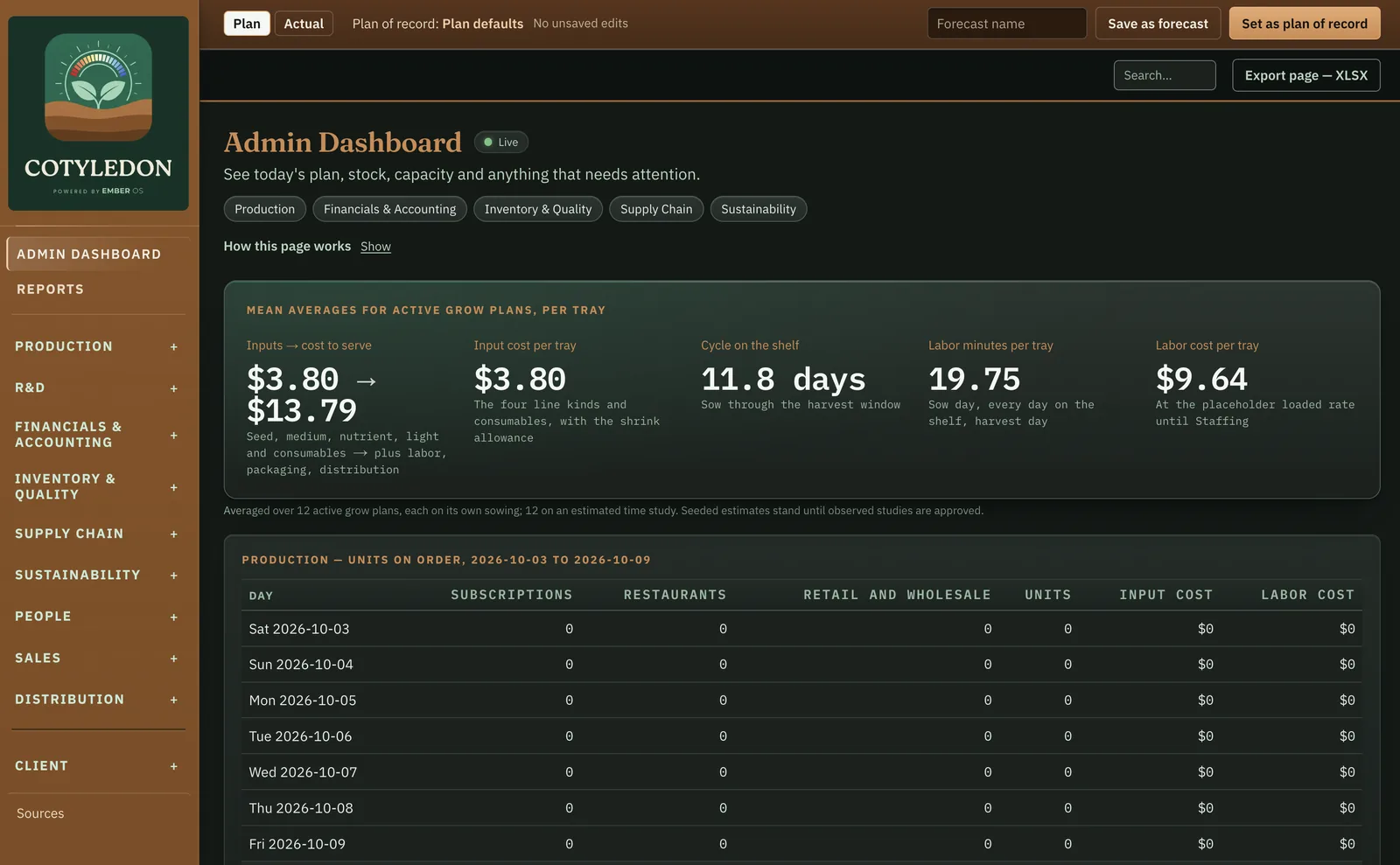
Two Applications
Two trades today, one engine underneath.
Each application keeps its own name, its own mark and its own vocabulary. Underneath they share the production engine, the ledger, the sustainability model and the rule that every figure shows where it came from.

Muse Kitchen
For scratch commissary kitchens
Recipes to batches to deliveries, with food safety, costing and the books in step. Fifty-one modules across twelve sections: production planning, day schedules and a floor time clock; HACCP control points and lot traceability; invoicing, receivables and payables; a facility planner that turns an equipment list into the square footage to lease; ten sustainability modules reported per meal; and portals for customers, suppliers and parents.

Cotyledon
For microgreens and sprouts growers
Grow plans to sowings to subscriber flats, scored against each client's nutrition targets. Fifty-seven modules across eleven sections: seed, growing media, nutrients and light costed per tray; a grow calendar planned back from distribution day; produce safety and lot traceability; subscriptions billed through Stripe as each flat is handed over; new blends run as recorded trials before they are offered; and a carbon and water footprint for every tray.
Cotyledon's planning, production and costing core runs today. Delivery routes, staffing and live card billing are still being finished, and the application sits behind a private preview gate until the first paying subscriber.
How The Engine Thinks
Four rules the whole system keeps.
They are the reason two screens never disagree about the same number, and the reason a lender, an auditor or a CPA can trust what they are shown.
Orders drive production
A batch or a sowing is exactly what the orders need, in whole units. Nothing is made to fill a rack or a kettle.
The plan is the cost
Every input line on a recipe or grow plan is priced from tagged reference data, so cost per unit is computed, never typed in.
Only real records post to the books
Plans and forecasts live in their own world. The ledger moves when a batch closes, a receipt lands or a delivery is handed over.
Every figure carries its source
Sourced, stated, derived, placeholder, unconfirmed or dated. A placeholder looks different everywhere it appears.
From Seed To Supper
One chain, from seed to supper.
Good food is a chain, and every link matters. Each stage runs on the application that speaks its language.
Seed
Organic and heirloom seed, every lot traced to its supplier
Soil
Growing media, nutrients and light, costed per tray
Grow
Sowings, stages and harvests on a living calendar
Prepare
Scratch recipes, batches and food safety
Serve & gather
Orders, deliveries, subscriptions and the people being fed
Muse Kitchen
Change one recipe, and everything downstream of it moves.
Give it the orders for a date and it returns the whole day: how many batches, which ingredients and how many cases, the labor hours, the equipment time, the packaging and the order to place, costed and netted against what is already in the cooler.
Move a portion size, swap an ingredient, add a customer, and the cost per meal, the margin, the labor hours and the order all move with it. You see what a decision costs while you are still deciding, not when the invoice arrives. The Day Schedule puts the whole operating day on a clock against your crew and tells you what will not fit while there is still time to change it.
Most kitchens run this on six systems that do not talk to each other, plus a folder of spreadsheets holding the gaps together. Here a change to a recipe moves the order, the schedule, the books and the carbon footprint at the same time.
Books that close, and food-safety records that hold up
Customers are invoiced on their own terms as deliveries complete, payments are applied, and supplier bills are matched against what actually arrived. Stock is tracked by lot and aged against its hold life. Temperature control points pass or fail on the record as the work happens, and any lot traces both ways, which is what a recall or an inspection asks for.
Facility planning from your own equipment list
List the units you plan to run and the platform gives you production floor, support rooms and total square footage by build phase, so you know what to sign for now and what you are growing into. Draw the floor and it checks the plan against plumbing, ventilation and health-code rules as you place units.
Scheduling and the time clock
Staff scheduling and a floor time clock run alongside production, so hours are captured where the work happens and go on to payroll without being re-keyed. A calendar view scans a whole month for the days that break.
Cotyledon
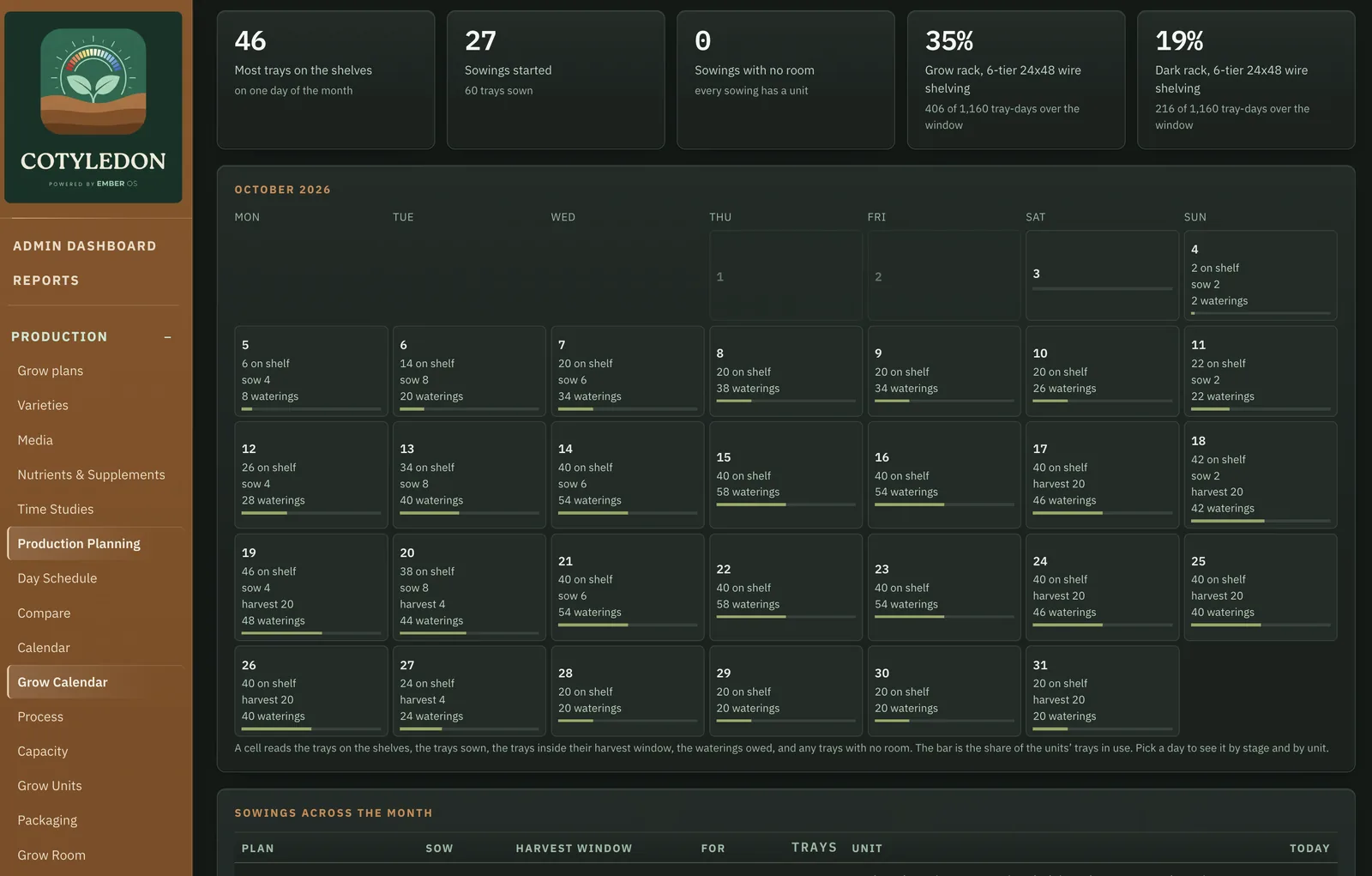
Every tray is counted back from its delivery day.
Standing orders become a sow schedule in whole trays, a daily task list for the crew, a purchasing list and a true cost per tray. A grower adding accounts sees what each new commitment takes in trays, shelf places, labor hours and dollars before making it.
Seeding density, soak, days under weight, blackout, photoperiod, light intensity and watering method by stage are written into each grow plan. A new hire works from the day's task list, and the operations manager stops being the only copy of the method. Dark stacks and lit shelves are counted in tray places against what the orders need, so the room's limits show up on screen before they show up as a short delivery.
Cotyledon was built from the founder's own production records at Vallecito Micro Farm in Bayfield, Colorado, where he grew twelve varieties and specialized in trays composed for individual clients. Each growing and nutrition claim in it cites a registered source.
Nutrition targets, scored
Each client carries named targets: iron, protein, sulforaphane, vitamin C, folate, fiber and more. The Flat Builder scores a flat against them from the variety profiles, and every benefit it shows cites its research source.
Subscriptions, billed as handed over
Weekly, every two weeks or monthly. A client can skip or pause a delivery up to its sow date. Each distribution is billed through Stripe when it is handed over, so a skipped one bills nothing.
Trials before the menu
A new variety or a custom blend runs as a recorded trial. Yield is read across runs before it is offered, and the cost is booked to research and development until the plan proves out.
Carbon and water per tray
CO2e by scope and water consumed for a tray and for a rack of twenty, built from energy, inputs, logistics and waste. Growing media are compared one forecast at a time, hemp mat against coir, jute and reusable mesh.
The Sustainability Suite
Sustainability reporting deep enough to hand to an auditor.
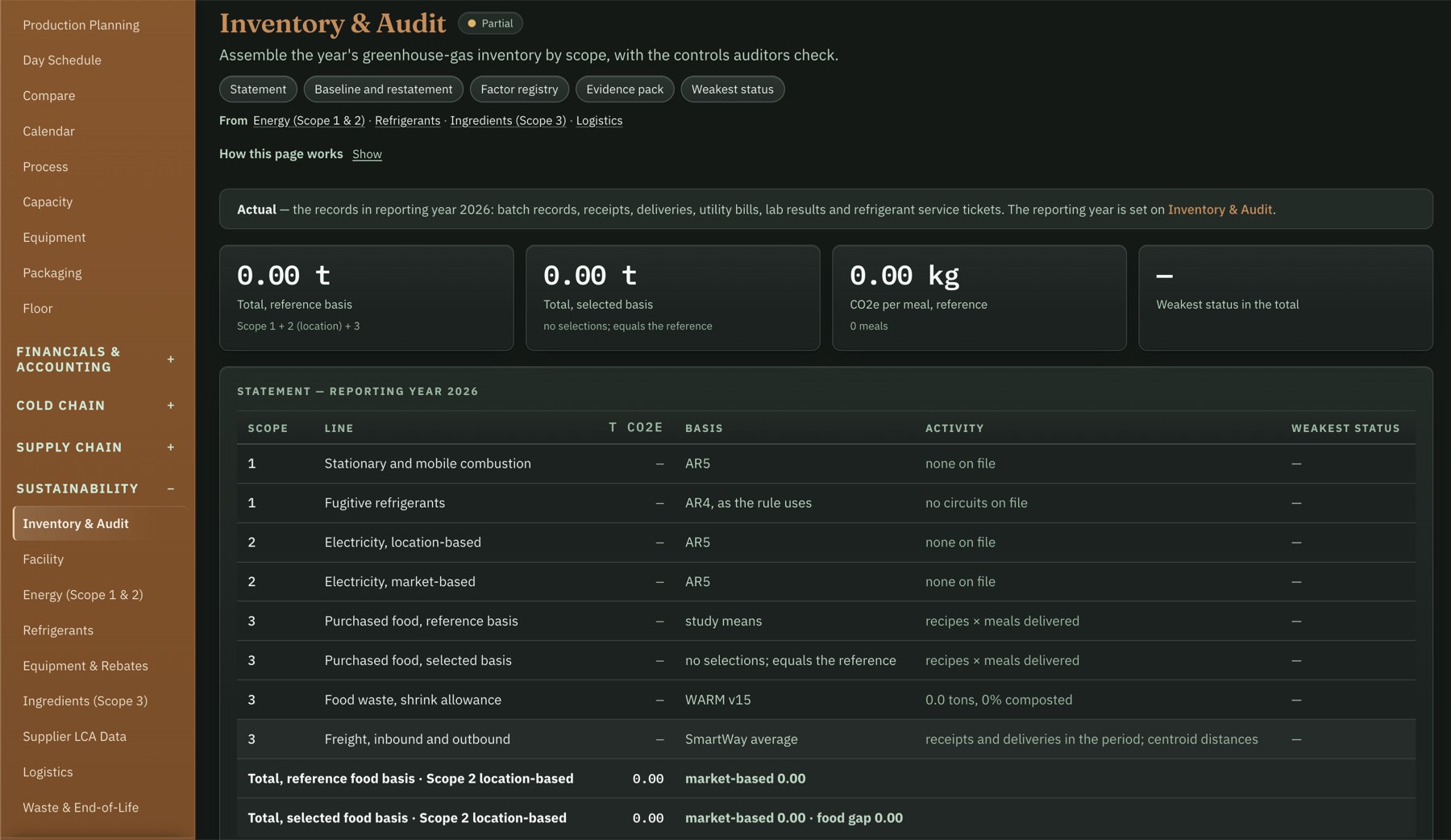
Ten modules in each application, covering ground most food software does not attempt: greenhouse gas by scope, energy, water, refrigerant leak rates, waste and composting, inbound and outbound freight, and the footprint of every input you buy.
It is not a separate sustainability spreadsheet. The numbers come off the same records as the accounts: the same deliveries, the same purchases, the same utility bills. In Muse Kitchen they land as a footprint per meal. In Cotyledon they land as a footprint per tray. Either way it is a number you can put on a proposal or a grant application.
Every line shows which emission factor produced it and which version of that factor, each one cited. Ingredient and input footprints run on two bases side by side, a published study average and your supplier's own figure, so you can see exactly what your sourcing is buying you. Set a baseline year and it flags the restatements. The whole inventory exports as an evidence pack with the source documents attached.
Portals
The people you serve do their own data entry.
Each portal has its own sign-in and its own shell, so customers, clients, suppliers and families work directly in the system instead of sending your staff emails to re-type.
Customers
Offices, caterers and school kitchens build their own orders. Pick a date, choose meals and quantities, say how to deliver. They see their order history, their invoices and what they have paid.
Clients
Each client signs in to their own account to see standing orders, upcoming deliveries and invoices, compose flats against their own nutrition targets, keep a card on file, and skip or pause a delivery. A change to a standing order arrives as a request the farm approves.
Suppliers
Producers keep their own catalog current: what they carry, what it costs, what the lead time is. Prices arrive from the people who set them rather than from a spreadsheet someone updates when they remember.
Parents
Families choose a child's meal plan, flag allergies, pick how they want to pay and see their payment history. School meal administration stops being a stack of paper in the front office.
Muse Kitchen's three portals are built and signed-in, with their submission flows and invitation links landing next. Cotyledon's Client Portal is built as pages, with live card billing and Flat Builder submissions still landing. The business owns the relationship with every stakeholder in one place rather than across three inboxes.
Agentic Assistance
Describe the change out loud. See what it costs.
A chef says what they want to change, in their own words, out loud if they prefer. What comes back is a costed version of the recipe to approve or throw away, and every number in it came from the same engine that costs everything else, not from the model.
Say it in plain language
Swap the potatoes for rice, buy the carrots pre-diced, drop the searing step. Typed or dictated, against any recipe in the library. No forms, no field names to learn.
It asks when it does not know
Where something is missing, whether a price, a yield or a cook time, it looks it up, works it out from what it has, or asks you. It never quietly makes one up, and anything you skip is carried through labelled as a placeholder.
See the cost before you keep it
The new version is priced against the original so you can see what the change does to cost per meal, yield and labor. Nothing reaches your recipe library until you click save.
Shipped in Muse Kitchen. Cotyledon's assistant, working on grow plan lines instead of recipe lines, is next.
Provenance
Know which of your numbers are still guesses.
Every figure says where it came from, on screen, every time it appears, so an estimate never gets mistaken for a quote, and you are never the last to find out which numbers in your own plan are still guesses.
Cited third party
Supplied by the operator
Working figure, no source yet
Calculated from other tagged rows
Believed, not verified
Sourced but old
The same goes for every code, rule, dataset, rate schedule and study the platform leans on: all of it is listed, with the citation and the document behind it, one click from the figure it produced. In Cotyledon that register includes the science library behind every stated nutrition benefit.
Built for the food business that has to answer for its numbers.
Muse Kitchen and Cotyledon run behind sign-in. Get in touch for access or a walkthrough of the operating model underneath them.